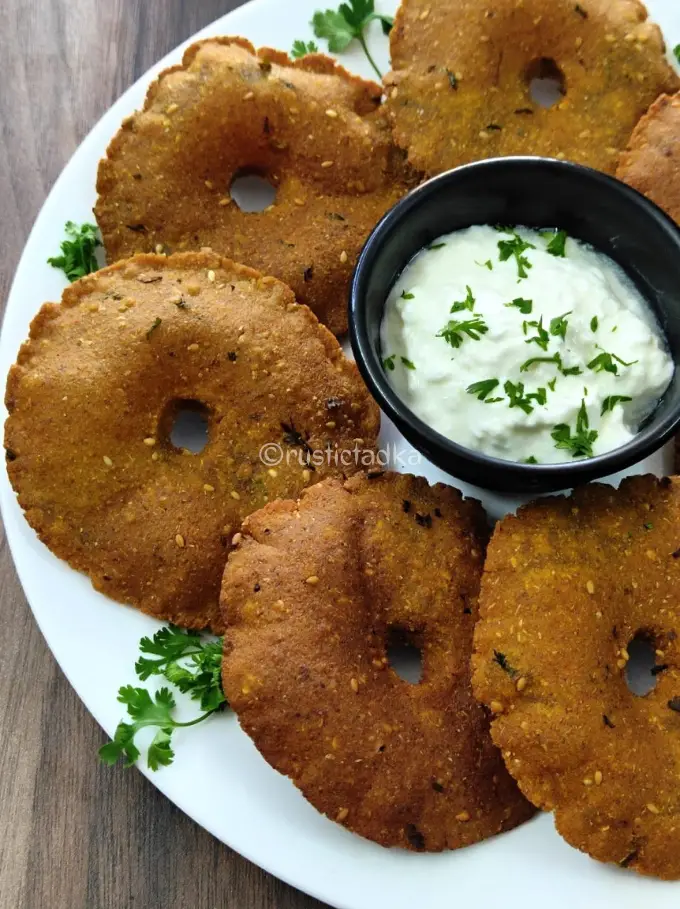
Bhajani Vade, also known as Bhajaniche Vade or Thalipeeth Bhajani Vade, are crispy Maharashtrian fried snacks made with traditional multigrain bhajani flour, spices and herbs.
These vade have a crisp outer texture with the earthy, roasted flavour that makes thalipeeth bhajani so distinctive. At home, this is one of those recipes that instantly reminds me of monsoon evenings, when hot crispy vade with a cup of ginger tea make the weather feel even better.
You can serve Bhajani Che Vade as a tea-time snack, with curd and chutney, or even as a side dish with a Maharashtrian meal. They are also convenient when you already have ready-made thalipeeth bhajani at home and want to make something different from regular thalipeeth.
What Are Bhajani Vade?
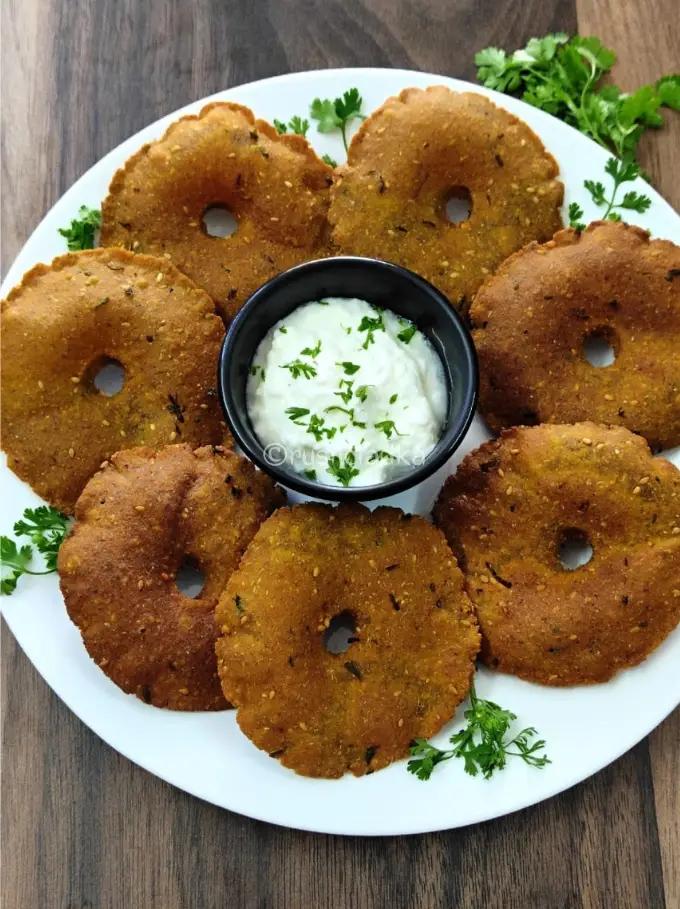
Bhajani Vade are deep-fried Maharashtrian flatbreads made using thalipeeth bhajani flour.
Unlike regular poori, which is usually made with wheat flour and tends to puff while frying, Bhajani Vade are flatter, more rustic and strongly flavoured with the roasted grains, lentils and spices in the bhajani flour.
They are sometimes described as multigrain poori because of the way they are shaped and deep-fried, but their flavour and texture are quite different from ordinary poori.
The exact bhajani blend varies from household to household and brand to brand, which means the colour, texture and flavour of the finished vade can also vary slightly.
What Is Thalipeeth Bhajani Flour?
Thalipeeth bhajani is a traditional Maharashtrian flour mixture made by roasting different grains, lentils and spices before grinding them together.
Common ingredients can include rice, jowar, bajra, chana dal, urad dal, moong dal, coriander seeds and cumin seeds. Some blends contain additional grains or pulses, and commercial versions can differ considerably.
Roasting the ingredients before grinding gives bhajani its characteristic nutty aroma and deeper flavour. This is why dishes made with bhajani taste very different from recipes made using plain wheat or rice flour.
The same flour is commonly used to make Maharashtrian thalipeeth, but it works beautifully for these crispy fried vade too.
Homemade vs Store-Bought Thalipeeth Bhajani
Traditionally, many Maharashtrian families prepared bhajani at home by roasting each grain, pulse and spice separately before grinding everything together.
Homemade bhajani is wonderful, but it does require planning and time. For everyday cooking, I often use good-quality ready-made thalipeeth bhajani because it makes this recipe much quicker.
If you already make your own bhajani at home, you can absolutely use it for these vade.
When using store-bought bhajani, always check the ingredient list because different brands use different combinations of grains and lentils.
Why These Bhajani Vade Turn Crispy
The texture of Bhajani Vade depends on three main things: the dough consistency, the thickness of the vade and the oil temperature.
The dough should be soft enough to shape without cracking but not loose or sticky. Adding too much water can make the vade difficult to shape and may cause them to absorb more oil.
The vade should also be flattened evenly. If they are very thick, the centre can remain soft while the outside browns.
Adding a little hot oil to the flour mixture before kneading can also help create a crisp texture. Traditional versions often use this technique when preparing the dough.
How to Make Crispy Bhajani Vade
Start by combining the thalipeeth bhajani with your spices, coriander, sesame seeds and seasoning.
Add the hot oil and mix it carefully into the flour. Once it is cool enough to handle, rub it through the bhajani so it is distributed evenly.
Add water gradually rather than pouring it all in at once. Different bhajani blends absorb different amounts of water, so it is better to judge the dough by feel.
The finished dough should be pliable and easy to flatten without breaking at the edges.
Letting the dough rest briefly also gives the flour time to absorb the moisture evenly.
Shape each portion into a flat disc and make a small hole in the centre. This helps the vade cook more evenly while frying. A similar shaping method is commonly used in traditional Bhajaniche Vade preparations.
How Thick Should Bhajani Vade Be?
Bhajani Vade should not be paper-thin like papdi, but they should also not be very thick.
Aim for an even medium thickness so the outside becomes crisp while the centre cooks properly.
If the vade are too thin, they can become very hard after frying. If they are too thick, they may remain doughy or soft inside.
Try to keep the thickness consistent across the entire disc, especially around the edges.
Why Do Bhajani Vade Break While Frying?
If your Bhajani Vade crack or break in the oil, the dough may be too dry.
Bhajani contains several different grains and lentils, so it can absorb water quickly. If the dough sits for some time, it may also become slightly drier.
Add a teaspoon or two of water and knead again until the dough becomes pliable.
Cracks around the edges while shaping are another sign that the mixture needs a little more moisture.
At the same time, avoid making the dough too wet. It should hold its shape easily when flattened.
Why Are My Bhajani Vade Hard?
Bhajani Vade can become hard if they are shaped too thin or fried for too long.
A very stiff dough can also make them harder after cooling.
Keep the dough pliable, make the vade moderately thick and fry only until they are crisp and evenly coloured.
Remember that the vade become slightly firmer as they cool, so they do not need to become extremely dark or dry in the oil.
What Temperature Should the Oil Be?
The oil should be properly hot before the first vada goes in, but it should not be smoking.
If the oil is too cool, the vade may absorb excess oil.
If it is excessively hot, the outside can brown before the inside cooks.
Once the vada is added, maintain medium heat and adjust as necessary so it cooks evenly and develops a crisp texture.
Your Guide to Easy & Tasty Indian Vegan Cooking
Ingredients For Bhajani Vade
In This Post
Thalipeeth bhajani
This is the main ingredient and provides the characteristic multigrain flavour.
Because every bhajani blend is slightly different, the amount of water required for the dough may vary.
Sesame seeds
Sesame seeds add a mild nutty flavour and a little extra texture.
Ajwain
Ajwain, or carom seeds, gives the vade a distinctive savoury aroma.
Coriander leaves
Fresh coriander adds freshness to the otherwise earthy bhajani mixture.
Green chilli
Green chilli gives the vade heat and can be adjusted depending on your preference.
Turmeric and red chilli powder
These add colour and flavour to the dough.
Oil
A small amount is mixed into the bhajani, and additional oil is required for deep frying.
Bhajani Vade Without Onion and Garlic
One of the nice things about this recipe is that you can easily make Bhajani Vade without onion and garlic.
Use the bhajani flour with coriander, chilli, sesame, ajwain and your regular spices.
This simple version lets the roasted flavour of the bhajani remain prominent and works particularly well with curd, chutney or thecha.
Bhajani Vade Variations
Bhajani Vade with onion
Finely chopped onion adds sweetness and moisture to the dough.
If using onion, chop it very finely so the vade are easy to shape and fry evenly.
Bhajani Vade with garlic and ginger
A little grated ginger or crushed garlic gives the vade a stronger flavour.
Use a small quantity so it complements rather than overwhelms the bhajani.
Methi Bhajani Vade
Finely chopped methi leaves can be mixed into the dough for a slightly bitter, aromatic flavour that works very well with the roasted multigrain flour.
Palak Bhajani Vade
Chopped spinach can also be added.
Since leafy vegetables release some moisture, add water to the dough gradually after mixing in the greens.
Peanut Bhajani Vade
Coarsely ground roasted peanuts can be added for extra nuttiness and texture.
Are Bhajani Vade Gluten-Free?
That depends entirely on the bhajani flour you use.
Some traditional thalipeeth bhajani mixtures are made from gluten-free grains and pulses such as rice, jowar, bajra and lentils, while other blends can include wheat. Commercial products vary widely.
If you need the recipe to be gluten-free, check the ingredient label carefully and make sure the flour was processed appropriately for your needs.
Do not assume that every packet labelled “thalipeeth bhajani” is automatically gluten-free.
What to Serve With Bhajani Vade
Bhajani Vade with curd
One of the simplest ways to serve these vade is with plain curd.
A little salt and roasted cumin powder sprinkled over the curd works beautifully with the spicy vade.
Bhajani Vade with thecha
Garlic thecha or green chilli thecha is perfect if you enjoy a spicy Maharashtrian combination.
Bhajani Vade with green chutney
Fresh coriander-mint chutney gives the vade a lighter, fresher flavour.
Bhajani Vade with tamarind chutney
Sweet and tangy tamarind-date chutney is a good option when serving these to children or anyone who prefers milder accompaniments.
Bhajani Vade with tea
Hot Bhajani Vade and ginger tea make a wonderful monsoon or evening snack.
This is one of my favourite ways to enjoy them at home.
Bhajani Vade with Maharashtrian meals
These vade can also be served as a side dish with usal, vegetables and other Maharashtrian dishes.
Traditional Bhajaniche Vade are also served with preparations such as matki usal.
Bhajani Vade for Monsoon and Tea-Time Snacks
Bhajani Vade make particularly good monsoon snacks because they are crisp, spicy and best served hot.
The nutty flavour of the roasted bhajani combined with green chilli and spices makes them satisfying even without elaborate accompaniments.
For a simple evening snack, serve them with hot chai and either curd, chutney or thecha on the side.
Because ready-made bhajani considerably reduces the preparation time, this is also a practical recipe when guests arrive unexpectedly.
Common Mistakes to Avoid
Adding too much water
Add water gradually.
Bhajani absorbs moisture differently depending on the blend, and an overly wet dough is difficult to shape.
Keeping the dough too dry
If the edges crack badly while shaping, the dough needs a little more water.
Making uneven vade
Uneven thickness causes some parts to become hard while others remain soft.
Flatten them as evenly as possible.
Frying in cold oil
Oil that is not hot enough can make the vade greasy.
Frying in extremely hot oil
Very hot oil browns the outside before the centre has enough time to cook.
Making the vade too thin
Very thin vade may become overly hard and crisp instead of having a pleasant texture.
Can Bhajani Vade Be Made Ahead?
Bhajani Vade taste best when freshly fried and still crisp.
If you need to prepare them a little in advance, allow them to cool completely before storing them so steam does not soften the surface.
For the best texture, I prefer making them on the same day they are served rather than storing them for several days.
If they lose some crispness, reheating them briefly in an oven or air fryer can help improve the texture.
How to Store Bhajani Vade
Let the fried vade cool completely before placing them in a container.
Avoid sealing them while they are still warm because trapped steam will make them soft.
If you plan to eat them later the same day, keep them covered at room temperature in a dry place.
For longer storage, refrigerate them and reheat before serving, although the texture will not be exactly the same as freshly fried vade.
Frequently Asked Questions
What are Bhajani Vade?
Bhajani Vade are Maharashtrian fried flatbreads made with thalipeeth bhajani flour, spices and herbs.
They are also called Bhajaniche Vade or Thalipeeth Bhajani Vade.
What is Bhajani flour made of?
Thalipeeth bhajani is usually made with a mixture of roasted grains, lentils and spices.
The exact ingredients vary, but commonly used ingredients include rice, jowar, bajra, chana dal, urad dal, moong dal, coriander and cumin.
Can I use store-bought Bhajani?
Yes.
Ready-made thalipeeth bhajani works very well for this recipe and makes preparation much quicker.
Can I use homemade Thalipeeth Bhajani?
Absolutely.
Homemade bhajani gives the vade an especially authentic flavour if you already prepare the flour at home.
Why are my Bhajani Vade breaking?
The dough is most likely too dry.
Add a small amount of water, knead again and make sure the vade are evenly shaped.
Why are my Bhajani Vade oily?
The oil may not have been hot enough when the vade were added.
Make sure the oil is properly heated before frying and maintain a steady medium temperature.
Why did my Bhajani Vade become hard?
They may have been rolled too thin, fried too long or made with dough that was too stiff.
Can I add onion to Bhajani Vade?
Yes.
Finely chopped onion adds flavour and moisture to the dough.
Can I make Bhajani Vade without onion?
Yes.
The traditional-style dough can be made very flavourfully without onion using coriander, chilli, sesame, ajwain and spices.
What goes well with Bhajani Vade?
Curd, garlic thecha, coriander chutney, tamarind chutney and hot chai all pair well with these vade.
They can also be served alongside a Maharashtrian meal.
Related Recipes
Bhajani Vade are a wonderful example of how traditional Maharashtrian ingredients can turn into a simple but deeply flavourful snack.
The roasted multigrain bhajani gives the vade their characteristic nutty flavour, while chilli, sesame, coriander and spices make every bite aromatic and savoury.
The most important things to remember are to keep the dough pliable, shape the vade evenly and fry them at the right temperature.
Once those basics are right, you get crisp, khamang Bhajaniche Vade that are perfect with curd, thecha or a hot cup of tea.
Whether you call them Bhajani Vade, Bhajaniche Vade, Thalipeeth Vade or multigrain poori, this is a traditional Maharashtrian recipe worth keeping in your snack collection.
More Traditional Maharashtrian Recipes
Lal Bhoplyache Gharge (Sweet Pumpkin Puffed Puri), Narlachi Vadi (Coconut Barfi), Sabudana Vada (Tapioca Fritters), Sabudana Khichadi, Valache Birde, Purnache Dinda (Sweet Steamed Dumpling), Narali Bhat (Sweet Coconut Rice)
How to make Bhajani Che Vade – Easy Crispy Vade Using Thalipeeth Bhajani
Looking for more delicious vegan recipes? Don’t forget to check out My Vegan eBook – packed with simple, flavorful dishes to make your vegan journey effortless and delicious!
If you like recipes like these, let’s connect on YouTube, Instagram & Facebook.
Thank you for stopping by, I would really love to know your thoughts on this recipe.
Also, do check out my Lifestyle Blog eralivine.com if interested.
Recipe Card
Bhajaniche Vade (Thalipeeth Vade Recipe) | खमंग खुसखुशीत भाजणीचे वडे | Multi-Grain Poori
Ingredients
Method
- In a mixing bowl, add thalipeeth bhajani (multigrain flour)
- Heat 2 teaspoons of oil until you see light fumes coming through
- Add this hot oil over the bhajani flour. Using a spoon mix the oil well with the bhajani.
- Mix the oil thoroughly into the bhajani until the mixture turns crumbly.
- Add spices, red chilli powder and turmeric powder. Add salt to taste, white sesame seeds (til) and coriander leaves.
- First, mix all the dry ingredients. Check for seasoning and adjust accordingly.
- Now, gradually start adding water & knead a firm but smooth dough.
- The quality of thalipeeth bhajani varies, hence adjust the water accordingly.
- Once bhajani dough is kneaded, cover & and set aside for 15 minutes.
- After resting the dough, knead the dough lightly once again. Divide the dough into small lemon-sized portions.
- Grease a parchment paper with a little oil. Place the dough ball on it & pat it into a small poori (Vade).
- Apply a little oil to your fingers if the dough sticks.
- Make a small hole in the center of the vade. This helps vade cook evenly. Don't make the vade thick otherwise, they don't puff up.
- Deep-fry vades – Carefully slide the vade into the hot oil. Press the vade lightly with a spatula so they puff up.
- Fry on medium flame. Flip often and fry vades till golden brown in colour and crisp.
- Once fried, transfer them onto an absorbent paper to drain excess oil.
- Fry all the remaining vades the same way. These make the best on-the-go snack for road trips.
- Crispy Bhajaniche Vade (Multigrain Poori) is ready. Serve them with curd or a side dish with meals or as a teatime snack.